
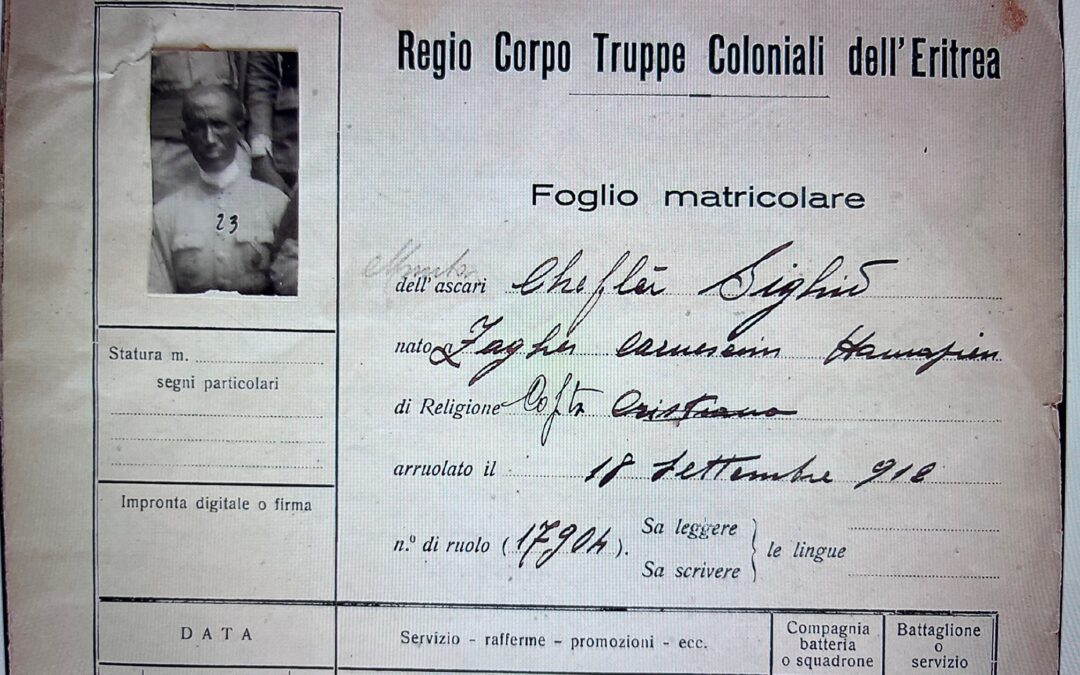
Chiflè Seghid was born in Zagher, a village in the Hamasien region of colonial Eritrea, not far from Asmara, the capital city of Italian colony Eritrea. His date of birth is unknown, but we know that he enlisted on 18 September 1912. This date marked the beginning of a 22-year career in the colonial army: more precisely 22 years and 8 months, as he was discharged on 15 February 1937 according to the Discharge Paper (Foglietto di congedo) states. The same document reveals the reasons for his discharge: impaired physical condition (menomate condizioni fisiche) and gives a short evaluation of his conduct: excellent. Other information about Seghid includes his religion (‘Coptic’) and his height (1.64 metres). A section of the paper is devoted to his commendable actions, which are summarised by reference to the major campaigns in which he distinguished himself: in Libya (1912–1935) and in the Italo-Ethiopian War (1935–1936). In the colonial army, he held the rank of ‘Muntaz’, an Arabic term adopted into colonial military language to refer to a rank equivalent to that of corporal in the Italian Royal Army. According to a contemporaneous military encyclopedia, this role involved commanding a team and was given to those among the askaris (private soldiers) who demonstrated leadership skills and could read and write Italian.[1] The enlistment paper of Chiflè shows a long list of movements between Libya and Colonial Eritrea in the years spanning between 1912 and 1937, with periods of leave and re-enlistments. Among his key features, the descriptions reveal him to be robust and durable, as well as respectful, polite and conscientious. However, the document also reveals that Chiflè was punished. According to his superiors, he needed to be urged to run errands, which is a subtle indication of the stereotypical portrayal of Africans in contemporary literature.
Since the beginning of Italian expansion in the Horn of Africa, troops of native soldiers have been recruited into the colonial army. However, large-scale recruitment of colonial subjects did not begin until Italy started in 1911 a war against Ottoman Libya to occupy those North African regions which were claimed in the spirit of radical imperialism and nationalism. The war was followed by a long fight with the local opposition to Italian rule.[2] Thousands of Eritreans, including Chiflè, enlisted in the army, driven by different motivations.[3]

Although a systematic investigation of African soldiering in the Italian Empire is still pending, recent research has innovated methodological approaches and expanded the range of sources consulted. An example is the so called ‘askari archive’, an archival collection of the Research and Documentation Centre (RDC) in Asmara, from which the biographical details on Chiflè Seghid are taken. Established after the country’s liberation following a thirty-year war of independence, the RDC was initially devoted to documenting this period. It now operates as Eritrea’s national archive and library, collecting and preserving historical archival records and printed material from Eritrea.[4] The above-mentioned collection of individual files is a unique source of information about members of the Italian colonial army from various regions of colonial Eritrea. The precise history of this collection remains to be written. Consisting of around 65,000 files, it contains compensation claims submitted by former colonial soldiers who, in the 1950s and 1960s, had the opportunity to receive compensation from the Italian Republic for their service to Italy. This compensation programme was initiated and promoted by the United Nations.
Asmara’s archives contain documents on former colonial soldiers with personal information and fixed characteristics on them, which express colonial knowledge and reproduce colonial mentality. Therefore, working with sources of this kind forces us to keep in mind the racialized context in which they were produced. This clearly apply also for the tiny file on Chiflè Seghid with the few and dry details on his life and military careers. Working on the topic of colonial veterans of the Italian Empire is fascinating for many reasons, not least because of the wealth of documentation available in several countries, including Eritrea. However, this abundance of documents also serves as a reminder of the inequalities encountered when writing colonial history. If the majority of sources employs colonial vocabulary, it is all the more important for us to subvert this imbalance, dissect those testimonies thoroughly, and find ways to access alternative accounts of the colonial past. Historians are asked to be more engaged about new sources to use and to enlarge the boundaries of traditional colonial archives.
The biographies of local soldiers in the colonial army have long been overlooked by historians of Italian colonialism. The contemporary narrative of local soldiers as loyal and committed subjects of the Italian colonial military mission endured long after the end of colonial rule, and the notion that they were second-class members of the army remains prevalent. In fact, examining the lives and experiences of local soldiers sheds light on the power dynamics in colonial and postcolonial contexts, which were shaped by a wide range of elements, demands and influences. As the documentation of the RDC shows, these dynamics affected not only the soldiers themselves, but their families as a whole.
In May 1939, Uobinese Chidane, a 20-year-old woman living in the Dembelas area wrote to the Seraye commissioner in Addi Ugri. This village was an ancient caravan post on the route from the Red Sea to the Tigray. Next to it, the Italians founded a new settlement called Mendefera.[5] She presented herself as the widow of a colonial soldier who had died fighting “rebels” in June 1938. The letter was probably dictated by Uobinese and transcribed by the local Addi Ugri scribe, as the stamp in the margin reveals. It was sealed with her fingerprint Literacy among women was rare.[6] Uobinese was left alone with two children and no financial resources. She therefore asked the colonial authority to provide her with her husband’s unpaid salary and savings. Although we know that the commando troops lost track of the soldier’s belongings, we cannot say whether his widow received a pension or compensation. Ultimately, we know very little about her, except that she was one of the many wives of Italian colonial soldiers, a group that has been largely excluded from historical analysis. The story of colonial veterans is also one of absence due to their deaths on the battlefield. Not all ex-soldiers were able to start a new life after leaving the military, nor did they manage to claim what they considered to be their entitlements. Many soldiers lost their lives in military campaigns, meaning that the only remaining accounts are those of their family members, such as their wives or mothers. Inclusive reconstruction of the past requires consideration of female colonial subjects and their scattered testimonies.

Another level of investigation can be considered when working with the RDC files in Asmara. In fact, they contain revealing information about the period following Italian rule, and haw individuals and families navigated this new era and the legacies of colonialism. Chiflè Seghid’s personal file, which opened piece, is particularly interesting in this regard because it deals both with his career during the colonial period and the long-term consequences of a military career. It raises questions about postcolonial relations between Italy and its former colonial subjects. A piece of paper stored in the file is a short letter in Italian written by Chiflè’ son to the Italian Consular Authorities in Asmara in 1962. In it, he emphasised that his father had served faithfully. In the final years of his career, he allegedly worked as a guard in an administrative office, a role commonly held by ex-soldiers. Thus, more layers of colonial and postcolonial history are contained within this tiny archive file and can help us to think about chronologies of lives and of political contexts. We also understand how the colonial experience became an intergenerational, shared family matter. In postcolonial times, children were well aware of life during the colonial era, just as the son of Chiflè knew about his father’s military career in the Italian army.
Following Italian rule in Eritrea came 11 years of British rule, from 1941 until 1952. After that, the country was federated with Ethiopia and was then annexed to it. The lives of former Italian soldiers continued amid different political circumstances, and the fact that they had served in a colonial army accompanied them in one way or another. Political participation emerged from this shared experience, and veteran groups were established. Many felt entitled to a pension and compensation for their service to the former colonising country. Further analysis is required to better understand these postcolonial relations. The RDC collection surely is an inestimable place for those who want to collect traces of lives of ex-soldiers of the Italian empire.

[1] Enciclopedia militare: arte, biografia, geografia, storia, tecnica militare, volume quinto, Milano, Istituto Editoriale Scientifico, Il popolo d’Italia, 1933, 390
[2] Eileen Ryan, Religion as Resistance. Negotiating Authority in Italian Libya, New York, NY: Oxford University Press, 2018
[3] See Gebreyesus Hailu, The Conscript: A Novel of Libya’s Anticolonial War (1950), translated by Ghirmai Negash, Athens, OH: Ohio University Press 2012, which is a wonderful literary elaboration of the fictional story of a askari who went to fight for the Kingdom of Italy in Libya.
[4] Azeb Tewolde, The archives of Eritrea as primary source of information for the Eritrean cultural heritage: its nature and accessibility, in: Rassegna di Studi Etiopici, 3^ Serie, Vol. II, 2018, 11-21
[5] Wolbert Smidt, Mändäfära, in: Encyclopaedia Aethiopica, vol 3, edited by Siegbert Uhlig, Wiesbaden, Harrassowitz, 2007, 725
[6] Massimo Zaccaria, Military Campaigning Abroad and Women’s Writing in Colonial Eritrea (1912–1918), in: Uoldelul Chelati-Dirar, Karin Pallaver (eds) Africa as Method, Singapore, Springer, 2024, 125-141